


SERVICES

Ecommerce integrations connecting catalogue, stock and operations

Operations become harder when suppliers, the store, logistics and invoicing use different data. We plan integrations with update rules, validation and monitoring.

Assess my store integration ↗

For stores repeating tasks across systems or needing product, availability, price and order synchronisation with defined rules.

Business owner and consultant reviewing their work together on a laptop.
Illustrative image

Map data before automating

Products, variants, prices and orders may move between several systems. We identify the source of each item of information and the identifiers connecting it. This avoids two sources updating one field without a priority rule, or mismatching different products.

Catalogue, stock and prices governed by business rules

Update frequency and unavailable-product handling need to reflect operations. We agree margins, exceptions and covered products before implementation. For incomplete or inconsistent data, we define how the process identifies it and what needs human review.

Logistics and invoicing within the journey

An integration can follow an order from the store to dispatch or invoicing. We map statuses, required fields and external service responses. Supplier dependencies and interface costs are considered so the flow remains viable day to day.

Test a sample and monitor execution

We validate representative products or orders, checking the result at each destination. Logs, warnings and exception handling help monitor the process after launch. RedeShop organises staged implementation, with criteria for extending the integration to the agreed set.
Data with a clear source

We define which system supplies and may change each piece of information.

Explicit update rules

We agree mappings, frequencies and exception handling.

Observable processes

We plan logs and validation to detect communication failures.

System and data map

Sources, destinations, identifiers and responsibilities.

Rules specification

Mappings, updates, conflicts and exceptions to address.

Integration and testing

Implementation of agreed flows and sample checks.

Operating plan

Logs, alerts and guidance for monitoring updates.

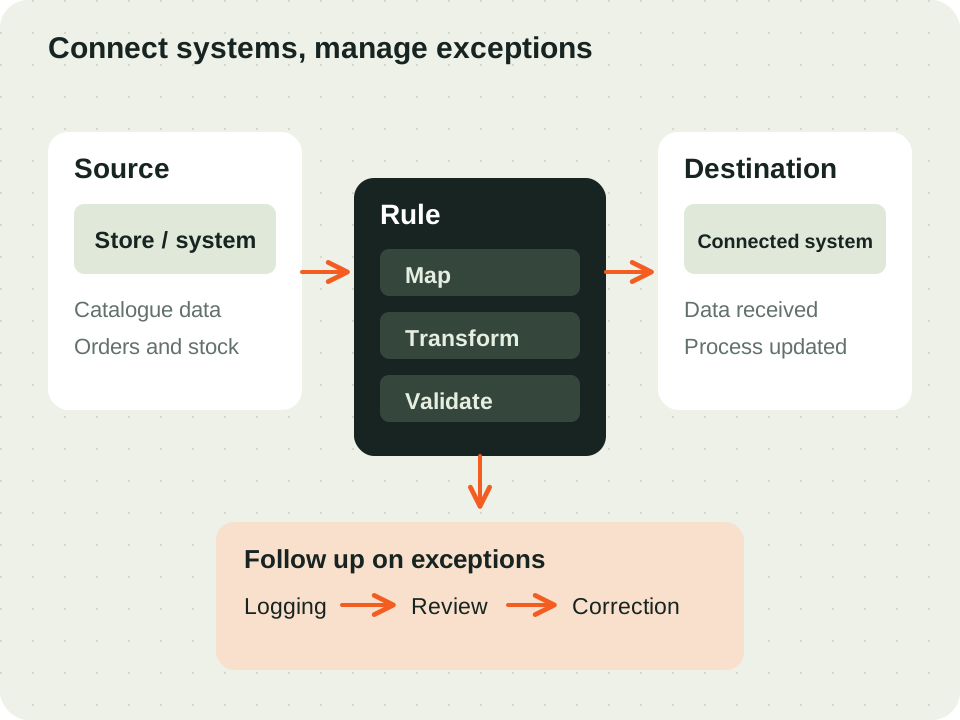
Each connection needs a data source, update rule and destination validation.
RedeShop editorial illustration · Each connection needs a data source, update rule and destination validation.
  1. 01

    Map operations

    We understand the systems, manual tasks and shared information.

  2. 02

    Define the rules

    We choose data sources, mappings and exceptions.

  3. 03

    Implement a sample

    We connect flows and compare destination results.

  4. 04

    Launch and support

    We extend the process and check logs and operation.

Can you connect a supplier to the store?

We assess the available data, identifiers, format and update requirements. The solution depends on the supplier’s interfaces and conditions.

Can the integration update prices automatically?

Yes, where that rule forms part of the project. Margins, limits, exceptions and data responsibilities are defined before implementation.

How do you handle products going out of stock?

We agree the rule: availability, visibility and updates may behave differently. We test the result to avoid unexpected catalogue changes.

Who monitors failures and API costs?

The proposal identifies responsibilities, external costs, interface limits and monitoring routines. The process should allow exceptions to be observed and addressed.

Talk to the team

Assess my store integration ↗

RedeShop assistant

AI to help with your enquiry

How can we help your business?

Virtual AI assistant to answer questions and guide your enquiry. The RedeShop team validates the proposal and supports the next steps.

Privacy policy ↗

You can also request contact without using AI.

Privacy policy